

Slowing down the economy? There is a better way
Raymond James Chief Economist Eugenio J. Alemán discusses current economic conditions.
Financial markets continue to grapple with a fundamental question: If inflation remains above target after years of restrictive monetary policy, is interest-rate policy still aimed at the right problem?
Inflation has stayed above the Federal Reserve's (Fed) target for six years and is projected to remain elevated for several more, per the Fed’s Summary of Economic Projections. Conventional thinking points to above-potential economic growth as the primary culprit, and there is certainly some truth to that view. However, today's inflation story is increasingly being shaped by forces outside the traditional demand cycle, including geopolitics, trade policy, fiscal expansion and structurally higher infrastructure and energy costs.
At the same time, aggregate growth is masking a significant divergence beneath the surface. Consumer spending remains resilient, but the spending power driving that resilience is increasingly concentrated among higher-income households. The result is a K-shaped economy in which a relatively small share of consumers accounts for a disproportionately large share of total spending.
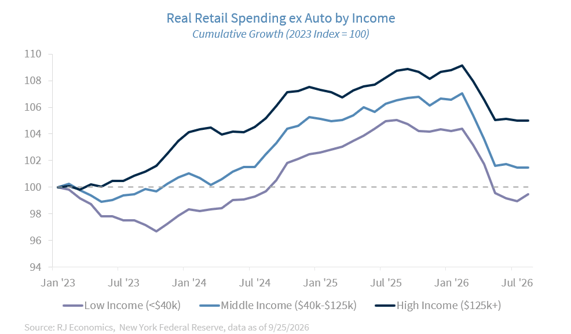
Corporate America has adapted quickly. Across sectors, firms are expanding premium product offerings and increasing segmentation to capture greater wallet share from higher-income consumers. Airlines provide one of the clearest examples. The traditional distinction between economy and first class has evolved into a range of offerings designed to maximize revenue per customer, e.g., basic economy, standard/main cabin, extra-legroom economy, premium economy, business/first class, etc. Similar trends are evident across hospitality, entertainment, financial services and consumer goods.
For investors, the implication is clear: Pricing power is becoming increasingly concentrated among companies with exposure to affluent consumers. The broad consumer may be under pressure, but premium-oriented business models continue to benefit from spending concentration at the top of the income distribution.
That said, today's environment differs significantly from the immediate post-pandemic period. Excess savings have largely been depleted, the household saving rate remains low and consumers continue to deleverage. As a result, the foundation supporting widespread consumption growth is weaker than it was several years ago.
This raises an uncomfortable question for policymakers. If households are reducing leverage and monetary conditions are already restrictive, what additional demand is higher interest rates expected to suppress?
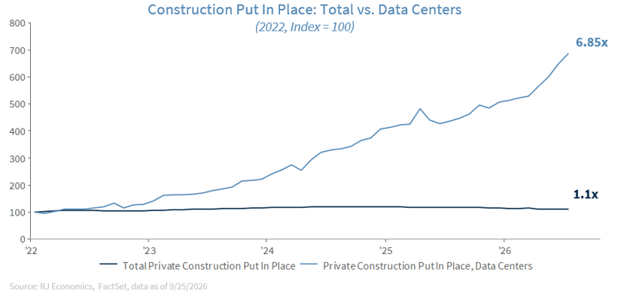
The answer matters because today's growth engine increasingly resides outside the traditional consumer cycle. Investment linked to artificial intelligence, data centers, energy infrastructure and public spending has become a critical driver of economic activity. Tightening monetary policy further risks slowing productive investment while doing relatively little to address inflation generated by supply-side shocks, fiscal expansion or geopolitical disruptions.
For markets, the larger risk may not be excessive monetary accommodation but an inefficient policy mix. Fiscal policy remains highly stimulative while monetary policy grows increasingly restrictive. The resulting policy conflict creates uncertainty, reduces economic efficiency and raises the possibility that growth slows before inflation fully returns to target.
In case of emergency, don’t ask politicians for solutions to economic issues
Markets generally respond favorably to policies that improve supply, investment and productivity. They respond poorly to policies that distort price signals. Unfortunately, periods of economic stress often increase the appeal of the latter.
Proposals such as price controls, rent controls, export bans and indiscriminate tariffs may generate political support because they appear decisive. Yet history suggests they rarely address the root causes of inflation and often create unintended consequences that worsen existing imbalances.
Invariably, and as the saying goes, “humans are the only animals that get burned over and over again,” and politicians have mastered this art. One potential explanation for this is because they don’t care about the future since, many times, they are not the ones paying for the consequences of that future. And it is not that we do not understand politicians’ objectives, we do. But these measures are shortsighted and probably are the reason there are not that many politicians that are also economists. This is not to say that economists are better than politicians; however, the incentives for politicians and economists are different and those differences affect the end result.
If there are politicians that are also economists and they suggest these solutions to address these types of economic problems, it is not their “homo economicus” (economic man) that is driving their actions, it is their “homo politicus” (political man) that is just looking at the immediate vote gratification, i.e., surviving the coming election.
The current debate in Washington surrounding a potential diesel export ban illustrates the problem. Diesel prices are at record highs primarily as a result of geopolitical disruptions in refined product exports from the Persian Gulf, due to the US-Iran conflict, and Russia, due to Ukrainian drone strikes. Restricting exports would not solve those physical supply constraints.
The US occupies a vital position in global diesel supply chains, accounting for roughly one-fifth of global seaborne diesel exports. Removing those volumes from the international market would tighten supply conditions further and likely push world prices higher. There could also be the side effect of widening the divergence in diesel prices between various US regions: The Gulf Coast, with plentiful refining capacity, might experience a diesel glut, whereas the East and West coasts might see even higher prices.
Moreover, refineries do not produce diesel in isolation. A reduction in refinery activity lowers output across the entire refined-product spectrum, including gasoline and jet fuel. What appears to be a targeted intervention in one market therefore risks creating broader distortions across the energy complex.
The lesson extends beyond diesel. Policies that interfere with market pricing mechanisms may generate temporary relief in isolated areas, but they often reduce investment incentives, constrain supply and exacerbate shortages over time. Investors understand this dynamic, which is why markets tend to reward policies that expand productive capacity and penalize those that suppress market signals.
Ultimately, inflation is best addressed by improving supply conditions, exercising fiscal discipline and avoiding policies that create additional distortions. The greater risk for markets may not be inflation itself, but policy choices that undermine the economy's ability to grow its way out of it.
1We typically like to look at these series in real terms, that is, taking inflation out of the equation, to see what is happening to these series without the distortion from inflation. In the graph we include both, year-over-year changes in nominal and real debt levels.
Economic and market conditions are subject to change.
Opinions are those of Investment Strategy and not necessarily those of Raymond James and are subject to change without notice. The information has been obtained from sources considered to be reliable, but we do not guarantee that the foregoing material is accurate or complete. There is no assurance any of the trends mentioned will continue or forecasts will occur. Past performance may not be indicative of future results.
