

Summer 2005 Newsletter to Clients
“The stock market climbs a wall of worry.”
– Old Wall Street proverb
For over 22 years I have been studying the investment techniques of great investors such as Templeton, Fisher, Graham, Buffett, Miller, Dreman, and others. In my quarterly newsletters I try to share some of what I have learned from these “Money Masters”. One theme common to all these investment greats is the need to control emotions when investing.
There is seemingly no limit to the amount of backward-looking analysis or forward-looking forecasting that bombards investors every day. With so much information to digest, it is no wonder that investors can give up and act on their emotions. How can one assess the impact of a “9/11” on Microsoft? In the end, we all believe that we act rationally. It is everyone else who acts irrationally.
“Your own mind is a sacred enclosure into which nothing harmful can enter except by your permission.”
– Ralph Waldo Emerson
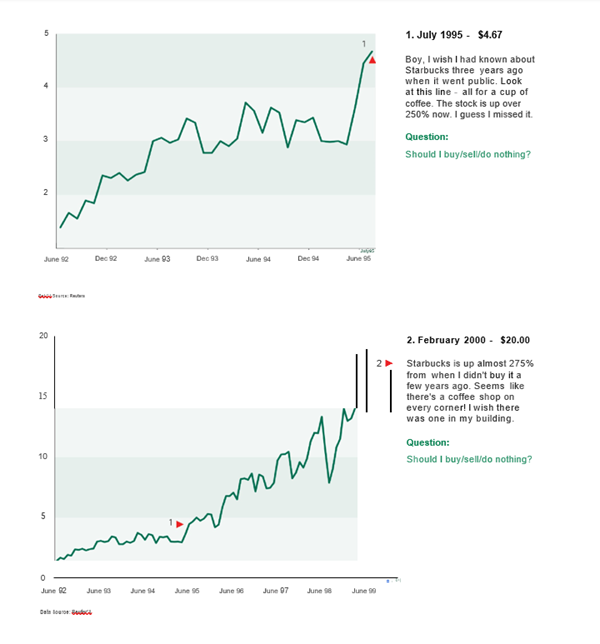
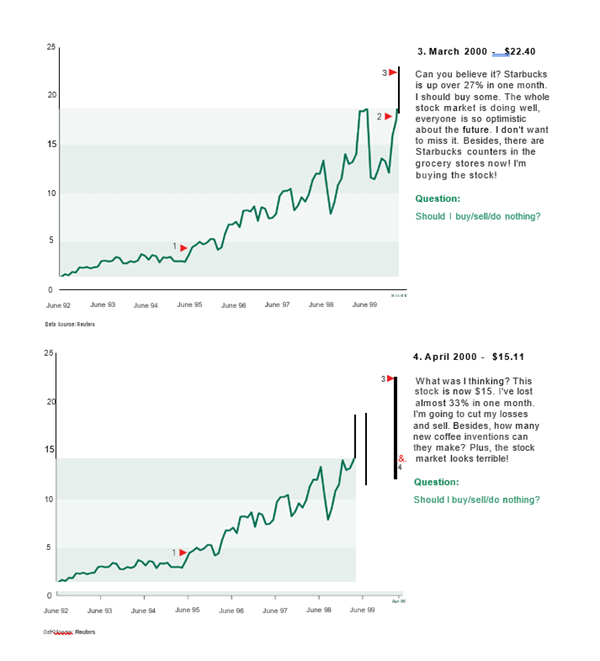
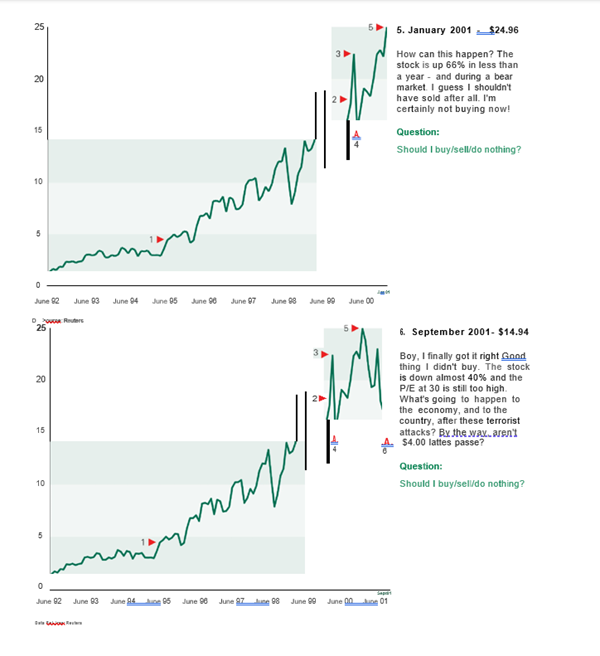
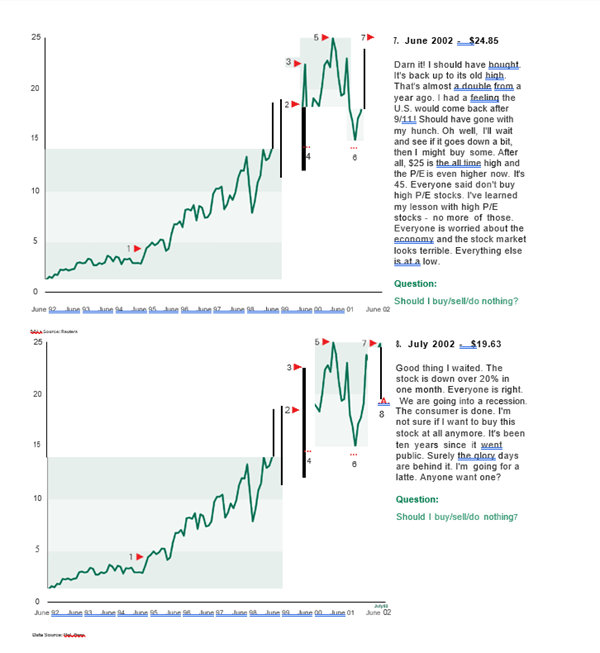
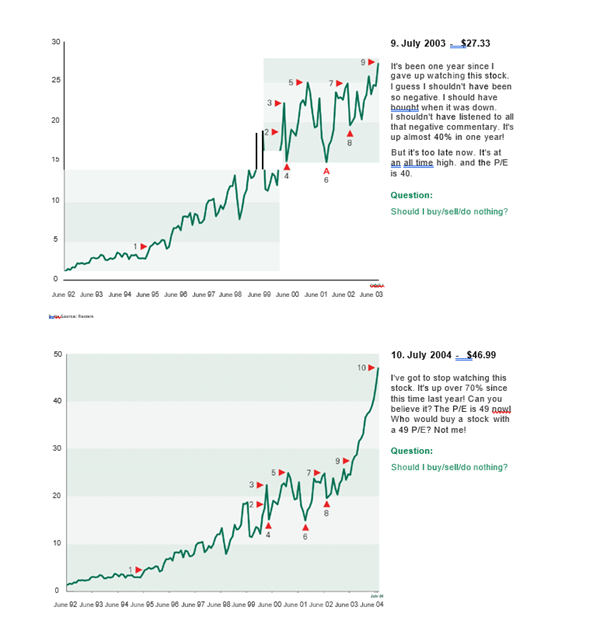
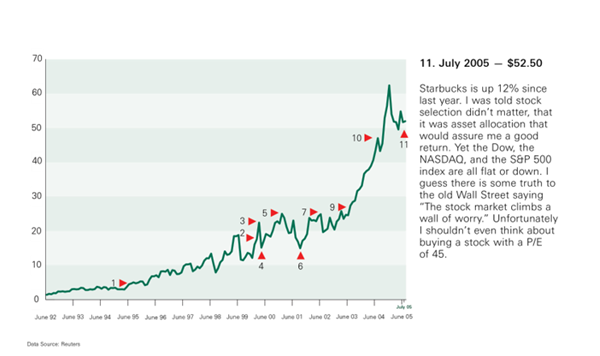
In this newsletter I will try to illustrate how emotions, despite our best intentions, can cloud judgment. Below are several charts of the monthly stock price movement of Starbucks Corp., a well-known coffee company, from its beginning as a public company until July 2005. Each price point represents the actual closing price that month. Next to each chart is commentary that, while fictitious, is symbolic of the range of investor emotion to Starbucks’ stock price movement. At the bottom of each comment section I ask the reader to answer the same question –should they buy/sell/do nothing? I have purposely left out any fundamental research available at the time. I have chosen to leave it out because even if the available research had been 100% true and accurate, investors, when forced into a buy/sell/do nothing decision, will often go with their emotion instead.
Please consider taking this emotions test. To get the full effect, do not skip to the end, you will ruin the surprise.
Epilogue
To this day, investors struggle with the question of whether to buy, sell, or do nothing with Starbucks stock. Is this a growth stock anymore? Can the company get any better? What about all the competition? And what about the economy? What impact might that have on Starbucks future? Is the stock expensive or cheap? Yet as all these thoughts swirl through investors’ minds, buffeted by emotion, the management of Starbucks endeavors to move the company forward.
As demonstrated by the success of Starbucks’ stock price, the buy and hold philosophy for investors is still valid. An investor smart enough to buy the stock in the early ‘90s needed only to “hang-on” and be patient – no small accomplishment. (See my earlier newsletter on the importance of patience.) It should also be obvious from this example that stocks can be volatile. The buy and hold investor surely had many points along the way at which to panic. Who would not be unnerved by a 30% or 40% decline (sometimes in one month)? Shrewd investors use volatility (and emotion) to their advantage. I do recognize that it takes a Herculean effort to buy when it seems everyone else is selling! Nevertheless, emotion would have allowed an investor to get into Starbucks stock nine years after it went public and still make a great return. (September 30, 2001 at $14.94 to July 29, 2005 at $52.50 is a 252% total return, dramatically different than the 25.1% return of the S&P 500 index over that time period.)
The final chapter of the story of Starbucks Corp stock has yet to be written. For those investors able to harness the power of investor emotion, there are, and will always be, stocks like Starbucks out there.
“I have had a lot of worries in my life, most of which never happened.”
– Mark Twain
AUDI PARTEM ALTERAM
Hear the Other Side.
Thoughts for Investors is a quarterly newsletter written for clients since 1997 by this author. The purpose is two-fold. First, it is meant to help explain the investment philosophy that guides the author’s approach to portfolio management. Second, it is meant to remind readers of important behavioral skills that the author believes are necessary to help them become successful investors. The author welcomes comments and criticisms, especially if they can be shared for the betterment of all investors. Quotation is permitted with full attribution.



