


Let's talk China, but don't be fooled by its propaganda machine
- 09.04.26
- Economy & Policy
- Commentary
Raymond James Chief Economist Eugenio J. Alemán discusses current economic conditions.
After a week of traveling abroad to meet with clients and discuss our outlook for the US economy and financial markets, we returned feeling the need to address a growing misconception, both in the United States and overseas, regarding the differences between the US and Chinese economies.
That is not to say the United States is without challenges. It faces inflationary pressures, widening fiscal imbalances, an unsustainable trajectory for government debt and weak employment growth, among other issues. However, China is not the economic paradise that many seem to believe it is.
Historically, dictatorial and totalitarian regimes have been highly effective at controlling information. In China's case, that responsibility falls to the Chinese Communist Party. In previous eras, such regimes maintained a near monopoly over domestic communications. Today, the landscape is different. Information is more decentralized, particularly outside China's borders. As a result, the strategy has evolved. Rather than controlling every channel, governments can shape perceptions by flooding the public sphere with selective information, exaggerations, half-truths and carefully crafted narratives. This is what many observers refer to as a sophisticated and highly effective propaganda machine.
Democracies are certainly not immune to political messaging, but there is a fundamental distinction. Communist systems excel at controlling domestic media and projecting favorable narratives abroad, while democratic systems generally allow competing views to coexist and challenge one another.
With that said, politics is not our primary focus here. We discuss it only insofar as it helps explain the Chinese economy. It is important to remember that China largely presents to the world what it wants the world to see, which is typically an image of uninterrupted success. And to be fair, many of its achievements are impressive, particularly in technology, given the relatively short period over which they have occurred. Some of that success has been driven by genuine entrepreneurship. Some has been achieved through aggressive industrial policies. And some, critics would argue, has involved cutting corners or violating accepted competitive norms.
This brings us to the question of how China has become so advanced in key technological sectors. Part of the answer lies in the ability of centralized governments to direct vast amounts of capital toward targeted industries. That is considerably more difficult in market-oriented economies, where resources are allocated through price mechanisms, profit incentives and what economists often call the “invisible hand.”
At the same time, Chinese policymakers appear to have learned lessons from the collapse of the Soviet Union. While both systems relied on centralized control, the Soviet model ultimately became mired in inefficiency. China has sought to avoid that outcome but we contend that, in the long run, they are bound to fail.
The Chinese system extracts significant resources from firms and workers while fostering intense competition among companies backed, directly or indirectly, by the state. Winners are rewarded, while losers are quickly pushed aside. The process resembles a state-sponsored version of survival of the fittest.
The electric vehicle industry provides a useful example. Some estimates suggest there were roughly 500 EV startups in China as recently as 2018. Today, the number of manufacturers has fallen to around 100, with approximately 40 companies accounting for the vast majority of production. Some analysts also argue that China's current EV production capacity is large enough to more than satisfy global demand.
As a result, Chinese automakers increasingly depend on foreign markets to absorb excess production. Their alternative is to export large volumes of low-cost vehicles. This helps explain why Chinese officials criticized the G20's recent concerns regarding excess capacity and cheap exports, characterizing such criticism as protectionist.
To sustain this model, China allocates an extraordinarily large share of national resources to investment. Real gross fixed investment accounts for roughly 40% of GDP in China, compared with about 18% in the United States. At the same time, personal consumption expenditures account for roughly 40% of GDP in China versus approximately 70% in the United States.
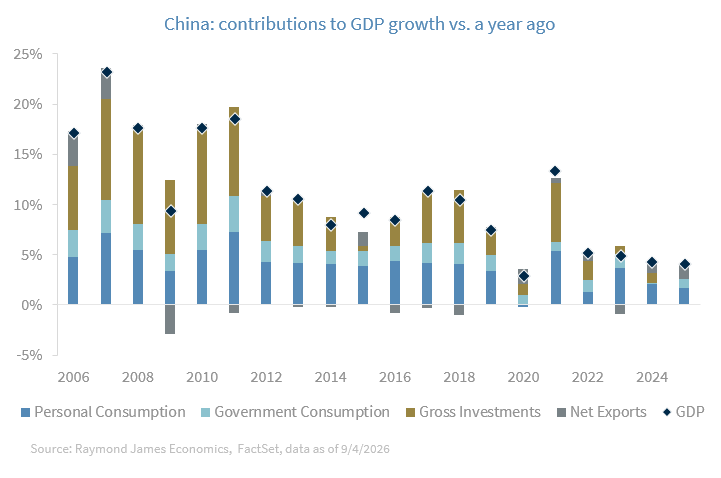
Excessive investment, however, comes with risks. The United States experienced those risks firsthand during the housing boom and subsequent Great Recession. China has faced similar consequences through the collapse of its own housing market.
Unlike in the United States, however, China's housing boom was heavily influenced by government-directed investment. The country has avoided a recession of the magnitude many expected largely because its capital account remains tightly controlled. To borrow from the Las Vegas slogan, what happens in China tends to stay in China.
Nevertheless, the damage has been severe. The effects of the housing collapse are likely to weigh on the Chinese economy for many decades. Having closed off one major investment outlet, policymakers have redirected resources toward advanced technologies and manufacturing. Those are the sectors being showcased today, leading some observers to question the long-term competitiveness of the US economy.
We believe that conclusion is mistaken.
The US economy remains capable of adapting, innovating and growing through the ups and downs of an imperfect business cycle. China, by contrast, operates under a fundamentally different economic model, one in which political decisions play a dominant role in determining economic outcomes.
Chinese policymakers learned from the housing crisis that homes could not serve as an export outlet for excess production. Housing is not tradable and foreign ownership remains highly restricted. Electric vehicles, however, are different. They can be exported.
As a result, EVs have become one of China's primary channels for absorbing excess industrial capacity. The country is selling that capacity to the rest of the world through exports of low-cost vehicles. This remains China's pressure-release valve, and it is likely to remain in place for as long as foreign markets are willing to absorb the excess supply.
1Animal spirits refers to “the instinctive, emotional, and non-rational factors – such as confidence, hope, fear, and spontaneous optimism – that drive human financial decisions and business investments under conditions of deep uncertainty, rather than purely mathematical or rational calculations.” Source: tutor2u
Economic and market conditions are subject to change.
Opinions are those of Investment Strategy and not necessarily those of Raymond James and are subject to change without notice. The information has been obtained from sources considered to be reliable, but we do not guarantee that the foregoing material is accurate or complete. There is no assurance any of the trends mentioned will continue or forecasts will occur. Past performance may not be indicative of future results.
