


The Iran conflict’s impact on oil prices
The evolving conflict in Iran could disrupt oil supply, pushing prices higher in the near term. However, as with most geopolitical events, the situation remains fluid, and while further price escalation is possible, history shows that geopolitical events tend to have limited and short‑lived impacts on the broader economy and financial markets.
Impact on oil prices
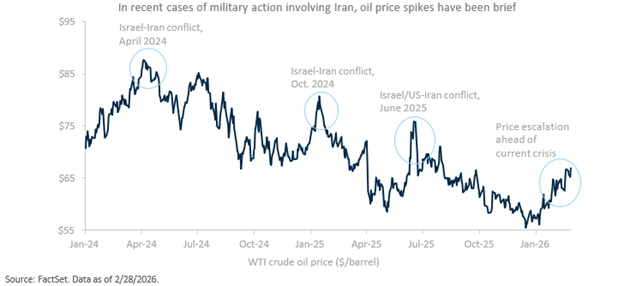
Markets had been anticipating that airstrikes would likely become a reality after weeks of US military buildup in the region and increasingly tough rhetoric from the White House. As a result, oil prices had already been climbing, reaching seven-month highs by Friday, February 27. The increase reflects the oil market’s risk premium, with prices rising beyond what supply and demand alone would justify due to geopolitical risk.
History offers perspective: Iran and Israel exchanged missile strikes twice in 2024, and oil continued to flow normally. The same was true during the conflict in June 2025. This time, however, the military action is more intense and widespread, including Iranian retaliation against other oil-producing countries. Still, if history is any guide, once the conflict subsides, oil prices tend to cool as the risk premium fades. The chart below reflects this dynamic.
How much oil supply is at risk?
Iran is a member of Organization of the Petroleum Exporting Countries (OPEC) and a sizable oil producer. Though, it exports less oil than many people might think.
Iran’s current production is about 3.2 million barrels per day, with domestic consumption of about 1.8 million barrels per day serving its population of approximately 93 million people. That leaves roughly 1.4 million barrels a day for export, about 1.4% of global supply, placing Iran 10th among the world’s oil exporters. As long as military action continues, oil tankers are avoiding Iranian ports.
A larger risk to global supply would be if tankers began avoiding the entire Persian Gulf. Under normal conditions, about 20% of the world’s oil, along with a similar share of liquefied natural gas, moves via the Persian Gulf and through the Strait of Hormuz, largely headed for Asian markets. A full closure or partial disruptions to the Strait of Hormuz would still represent meaningful risks to supply and could trigger short‑term price spikes.
Looking ahead, geopolitical risks are set to remain sources of short-term volatility in oil prices, but long-term market trends are driven by supply and demand dynamics. With global demand growth remaining sluggish and plentiful increases in supply from countries such as Brazil and Guyana, the year-end WTI target of $55 to $60 per barrel reflects fair value for oil prices, setting aside the current risk premium. Also, OPEC recently decided to boost supply in April by 206,000 barrels per day.
Impact on equities and bonds
Iran’s role in the global economy is limited because of decades of isolation. Its primary significance is as an oil producer. More broadly, US companies have relatively little direct exposure to the region: The S&P 500 generates less than 2% of its total revenue from the Middle East. That means if global stock markets come under pressure, it’s likely driven more by a short-term reaction to geopolitical headlines than by any meaningful hit to corporate fundamentals.
Overall, minimal impact on corporate earnings is expected, assuming the conflict remains short-lived. Higher oil prices tend to benefit the energy sector, while creating modest cost pressures for industries, such as airlines and trucking.
The picture would change if elevated oil prices were to persist for several months. In that scenario, US consumers would likely see gasoline prices rise above $3 per gallon, pushing inflation modestly higher while weighing on consumer confidence and spending.
The combination of slower consumer spending and stickier inflation would complicate the Federal Reserve’s decision making around future rate cuts. Even then, the spill over into bond markets would likely be limited.
Beyond a brief bout of risk-off positioning that could push longer-term rates lower, we see little lasting impact on 10-year Treasury yields, which are still expected to drift higher toward 4.25% to 4.50% by year end.
Bottom line
This latest crisis involving Iran has pushed up oil prices and may put short-term pressure on risk assets. History suggests, however, that these episodes are temporary, with oil prices eventually easing back toward more moderate levels. Geopolitical shocks are a recurring feature of markets. Maintaining discipline during periods of uncertainty remains a key driver of long-term investment success.
All expressions of opinion are those of Investment Strategy and are subject to change. This information should not be construed as a recommendation. The foregoing content is subject to change at any time without notice. Content provided herein is for informational purposes only.
There is no guarantee that these statements, opinions or forecasts provided herein will prove to be correct.
Past performance is not a guarantee of future results. Indices and peer groups are not available for direct investment. Any investor who attempts to mimic the performance of an index or peer group would incur fees and expenses that would reduce returns. No investment strategy can guarantee success. Economic and market conditions are subject to change. Investing involves risks including the possible loss of capital.
The information has been obtained from sources considered to be reliable, but we do not guarantee that the foregoing material is accurate or complete.
Diversification and asset allocation do not ensure a profit or protect against a loss. Investing in oil involves special risks, including the potential adverse effects of state and federal regulation and may not be suitable for all investors.
Source: FactSet
